
Hip dysplasia is a common orthopedic condition affecting dogs. At Edinger Surgical Options, our surgeons provide comprehensive evaluation and advanced surgical treatment for dogs affected by hip dysplasia and the osteoarthritis that can develop as a result.
Our team offers multiple surgical options, including femoral head ostectomy (FHO), and total hip replacement (THR). We decide on treatment case by case. We consider how severe the disease is, along with your dog's age, size, activity level, overall health, and expected quality of life.
What Is Hip Dysplasia?
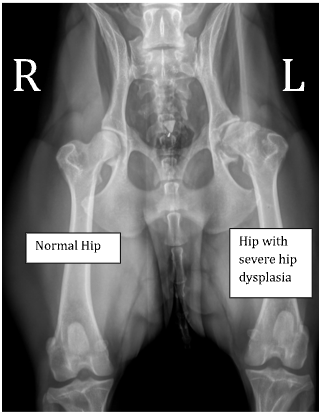
Hip dysplasia is a developmental abnormality in which the hip joint does not develop normally, resulting in excessive looseness, or laxity, between the femoral head and the acetabulum—the socket of the hip joint.
Over time, abnormal movement within the joint can lead to progressive damage, including thickening of the joint capsule, changes to the shape of the femoral head and acetabulum, and the development of osteoarthritis. While some dogs with hip dysplasia may remain comfortable for years, others develop significant pain, stiffness, and lameness as the disease progresses.
Diagnosing Hip Dysplasia
Diagnosis begins with a thorough orthopedic examination and review of your dog's medical history and clinical signs. Our surgeons evaluate the hips for pain, decreased range of motion, instability, and changes in gait or limb use.
Diagnostic imaging is an important part of evaluating hip disease. X-rays allow our surgeons to assess the structure and alignment of the hip joints, identify changes associated with hip dysplasia and osteoarthritis, and determine the extent of joint degeneration. In more complex cases or when advanced surgical planning is needed, CT imaging may also be utilized to provide detailed three-dimensional information about the bones and joints.
Once the diagnosis and severity of the disease have been established, our surgeons will discuss the available treatment options and help determine which approach is best suited to your dog.
Femoral Head Ostectomy (FHO)
A femoral head ostectomy, also called a femoral head and neck excision, is a procedure designed to eliminate the source of pain associated with a severely damaged hip joint.
During surgery, the diseased femoral head and neck are removed. This eliminates the painful bone-on-bone contact between the femoral head and acetabulum. Rather than creating a new artificial joint, the body forms a fibrous connection supported by the surrounding muscles.
An FHO can provide significant pain relief and improved limb function, particularly in appropriately selected patients. However, the resulting hip does not function like a normal hip, and some dogs may have limitations in strength, range of motion, or athletic performance.
Total Hip Replacement (THR)
For dogs with severe hip dysplasia and osteoarthritis, total hip replacement can provide the opportunity to restore a more normal, pain-free hip function.
During a total hip replacement, the damaged femoral head and neck and the diseased acetabulum are replaced with prosthetic components. The artificial femoral and acetabular components recreate the structure of the hip joint, eliminating the painful surfaces of the diseased joint.
Our surgeons use advanced imaging and surgical planning to help achieve accurate implant positioning and optimal joint function.
Following surgery, our RECOVERY STAY™ program provides round-the-clock postoperative care and rehabilitation, helping patients safely progress through the early stages of recovery.
Why Total Hip Replacement Is the Gold Standard
For dogs with severe hip dysplasia and arthritis, total hip replacement is widely regarded as the gold standard, the one procedure that replaces the diseased joint entirely and restores near-normal, pain-free hip function. Rather than simply managing pain, it addresses the problem at its source. Here is why our team recommends it with confidence for the right patients.
The Best-Documented Results in Hip Surgery
The evidence behind hip replacement is exceptional. Across decades of research and hundreds of published studies, roughly 90 to 95 percent of dogs—and in some reports more than 97 percent—regain good-to-excellent, pain-free function after total hip replacement. Force-plate studies, which objectively measure how a dog loads the limb, confirm that a replaced hip performs far more like a normal hip than the alternatives. Most dogs return to walking, running, swimming, and stairs comfortably, often for the rest of their lives.
A Safe Procedure in Experienced Hands
As with any advanced orthopedic procedure, complications are possible—most commonly dislocation of the new joint, and less often loosening, infection, or fracture—but these are uncommon, occurring in roughly 5 to 10 percent of cases, and the great majority are treatable. Careful surgical planning, precise implant positioning, and a controlled recovery are what keep these risks low, which is why THR should be performed by an experienced surgical team.
Results That Last a Lifetime
Total hip replacement is also remarkably durable. In most dogs, the implants are designed to last the rest of their life, and modern cementless systems form a strong, lasting bond with the bone. Owner satisfaction in long-term studies is consistently very high—typically well over 90 percent—with most dogs needing no further arthritis medication for the treated hip after they recover.
Why Hip Replacement Usually Outperforms FHO
By comparison, femoral head ostectomy (FHO) is best thought of as a salvage procedure—a very good way to relieve pain when total hip replacement is not an option, but one that does not recreate a normal joint. Because the femoral head and neck are removed and the body forms a fibrous “false joint,” dogs can be left with some limb shortening, reduced range of motion, and ongoing muscle loss, and a full return to normal function is not guaranteed. FHO tends to work best in smaller, leaner, or very active dogs. When a dog is a candidate for total hip replacement, THR is almost always the better choice.
The Best Path Back to a Normal Life
For dogs with painful hip dysplasia and arthritis, total hip replacement offers the closest thing to a brand-new hip, and for most of these patients, it is the treatment we recommend whenever it is feasible. Our surgeons will help you determine whether your dog is a candidate and will guide you through every step, from planning through a fully supported recovery.
Choosing the Right Hip Surgery
There is no single surgical solution that is appropriate for every dog with hip dysplasia. Our surgeons consider the individual patient, the severity of hip disease, lifestyle, activity level, and long-term goals when recommending treatment.
In some young dogs diagnosed before arthritis develops, additional options may be considered. These can include procedures that reshape or reposition the pelvis to improve hip coverage, and, in very young puppies, a minimally invasive procedure that guides the growing hip into a tighter fit. Because these approaches depend heavily on age and the stage of disease, early evaluation gives us the most options.
For total hip replacement, reported success rates are high—commonly in the range of 90 percent or more—with most dogs returning to comfortable, athletic function on the treated hip. Complications such as implant loosening, dislocation, or infection are uncommon but possible, which is why careful surgical planning and a controlled recovery are so important. Femoral head ostectomy also provides good pain relief in appropriately selected patients, and tends to work best in smaller, leaner, or very active dogs whose muscling supports the resulting “false joint.”
Whether an FHO or total hip replacement is appropriate, our goal is the same: to reduce pain, restore comfortable function, and give your dog the best possible opportunity for an active quality of life.
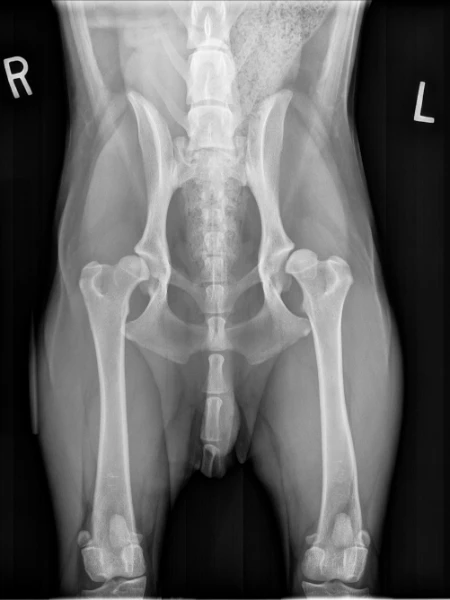
Pre THR surgery
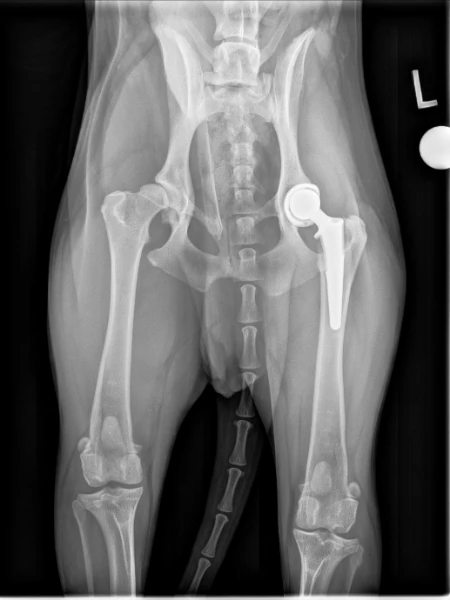
Post THR surgery
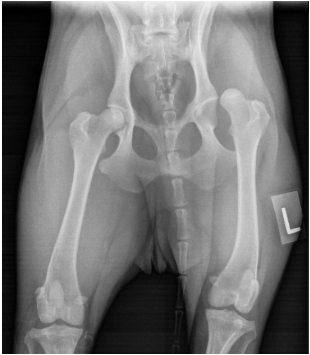
Pre FHO surgery
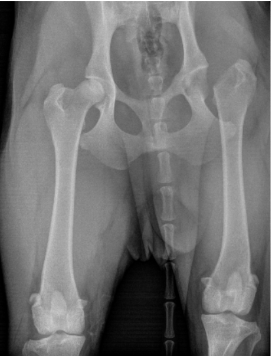
post FHO surgery